GREAT POINT CAPITAL ANNOUNCES PLANS TO BUILD A
MAJOR FILM & TV STUDIO COMPLEX IN BUFFALO, NY
Buffalo set to become Upstate New York’s premier filming destination
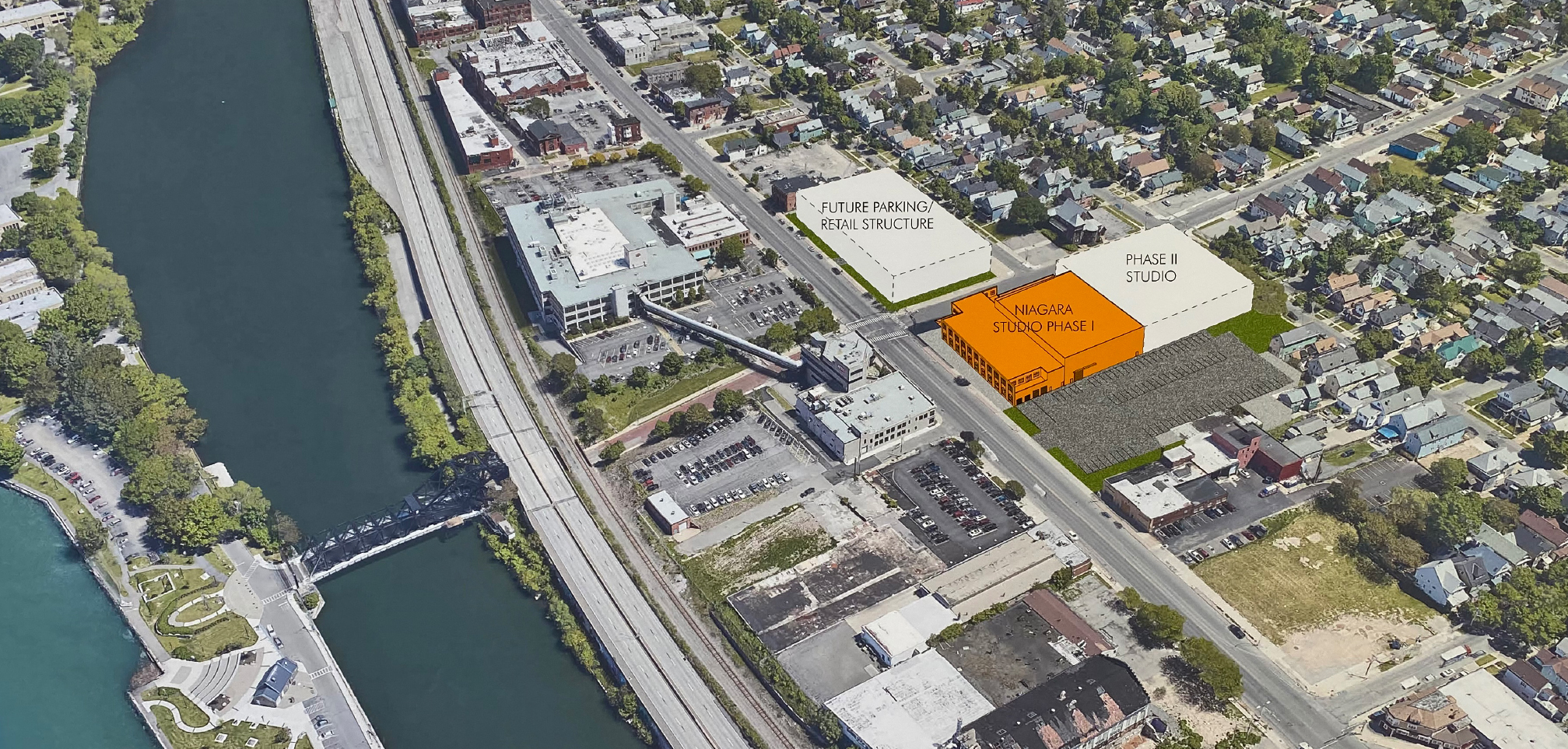
Buffalo, NY – June 30, 2020 – Great Point Capital Management, a media-focused investment fund run by Robert Halml and Fehml Zeko, today announced it has filed plans with the city of Buffalo to build a major new film and television studio complex. Earlier this year, Great Point signed a deal with Rich Holdings Inc. to purchase a building site for the studio on land adjacent to Rich Products, Niagara Street campus.
The $50+ million full-service film and television production facility will include two 20,000-square-feet stages and 70,000-square-feet of office and support space. The studio will be built in two phases, with construction on Phase-1 slated to start this September with projected completion in autumn 2021.
Fehmi Zeko, co-founder of Great Point Capital said, “Buffalo is an ideal city for a state-of-the-art film and television complex. A combination of great locations, well-trained crew and tremendous support from local government, has made Buffalo a desirable destination for filmmakers. With the addition of the studio, Buffalo will see year-round activity.”
Rich Holdings Inc., a key investment partner and a long-time corporate force in Buffalo has been instrumental in bringing this opportunity to fruition. Bill Gisel, executive vice chair of Rich Holdings, Inc. said, “The new studio facility will provide an immeasurable boost to film-making and television production in Buffalo, and we are thrilled that our West Side Promise Neighborhood will be at the center of it”.
Longtime local developer and former CEO of the Buffalo Sabres, Larry Quinn, will be coordinating and supervising all aspects of the project for Great Point. Buffalo based architecture firm, Architectural Resources, is designing the studio with Krog Corporation acting as construction manager and builder. Great Point will be using Buffalo subcontractors and the local labor force to complete the building.
The studio is expected to be a big boost to the local economy. In addition to the many full and part time jobs which will be created at the complex, films utilizing the studio will source catering, security, cleaning crews, transportation and housing locally.
The Mayor of Buffalo, Byron Brown, said “Buffalo continues to emerge as a film-friendly city and the building of a major film and television studio complex, here in our community, is a game-changer for our community and a positive statement of the long-term confidence Great Point Capital Management and Rich Holdings, Inc. have in our City’s growing film and television industry,” stated Buffalo, New York Mayor Byron W. Brown. “This $50+ million investment means new employment opportunities for City residents and more business for those around the City who support Buffalo’s thriving film sector.”
This will be the second studio complex under construction for Great Point Capital. Construction on their Lionsgate Studios in Yonkers, NY has resumed after a three-month Covid-19 hiatus. Great Point is n discussions with numerous television companies that are considering the role as anchor tenant for the Buffalo Studios.
“As a Western New Yorker, I am proud that Buffalo is emerging as the top destination to film in Upstate New York,” said Lt. Governor Kathy Hochul. “The addition of this major film and TV studio complex means more jobs, more business and more opportunities to showcase our friendly city and unique Western New York region. As we continue to contain the spread of the coronavirus, we are simultaneously building back Western New York better than ever before and further putting the City of Buffalo on the map.”
Adviser to the fund is London-based Great Point Media Group, a diversified media and entertainment company owned by Jim Reeve and Robert Halmi (who will also be an investor in the new studios). Great Point Media Group has provided investment and arranged financing for more than 50 production companies with clients including Lionsgate, Netflix, Amazon, Hulu, Google, Sky, BBC, ITV, Universal, AMC, Hallmark, Sony and Paramount.
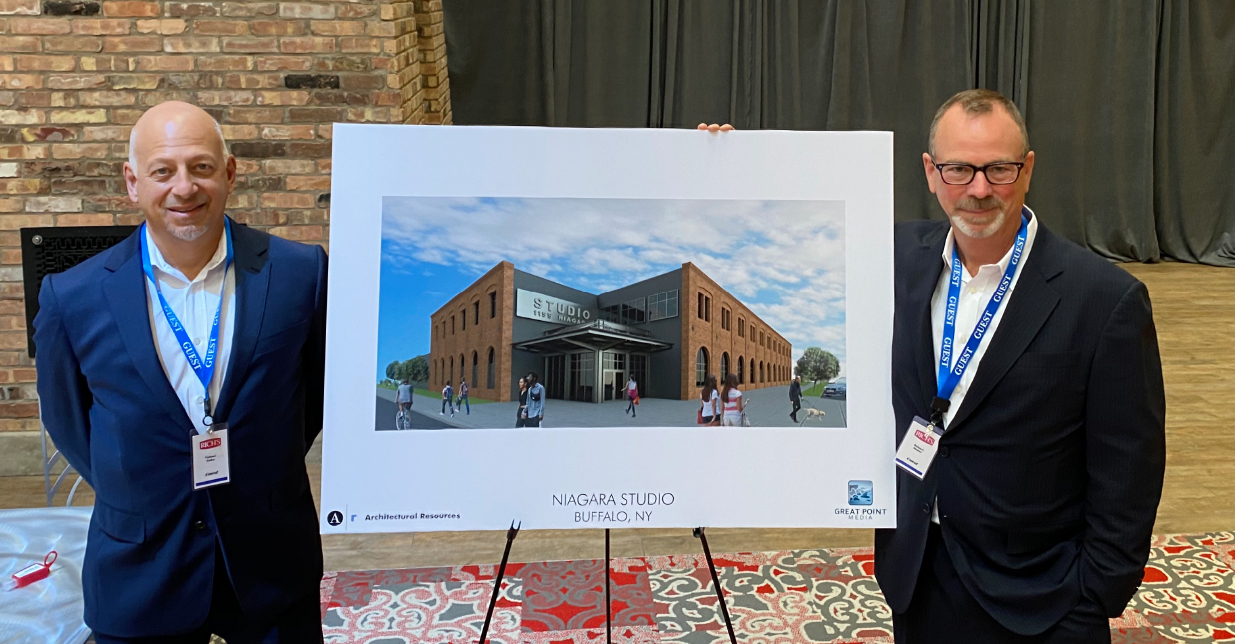
(Pictured L-R) Fehmi Zeko and Robert Halmi of Great Point Capital at today’s press announcement at the Rich Products Atrium.
ABOUT GREAT POINT CAPITAL MANAGEMENT
Great Point Capital Management is a media-focused investment fund specializing in film and television infrastructure concentrated on investments in qualified economic opportunity zones. The general managers are Fehmi Zeko and Robert Halmi. They are presently expanding into new studio investment/management businesses in other locations in North America and the U.K.
Robert Halmi is the founder of the Hallmark Channel and was Chairman of Crown Media. Robert has been the Chief Executive Officer of four public companies. As President and CEO of Hallmark Entertainment, Robert transformed the business from a small production company into one of the first modem studios, with production, distribution and broadcast all in one company. Under Halmi’s leadership, Hallmark Entertainment produced over 2,000 hours of original content. Halmi is an active member of the Academy of Television Arts & Sciences and serves on the board of the International Emmy Committee. He is also Chairman of Great Point Media, a U.K.-based media group, which will provide synergistic opportunities for Great Point Capital Management.
Fehmi Zeko has established a record of helping global technology, media and telecommunications clients build strong companies and deliver profitable growth through landmark M&A, turnaround and growth initiatives. Fehmi has led the banking strategies in global communications, media, entertainment and telecom at Bank of America, Macquarie Capital, Deutsche Bank and Citigroup. Fehmi has had consistent success providing operating advice and capital to drive the completion of hundreds of transactions and raising hundreds of billions in equity and debt capital. He has built, led and/or expanded market sector practices in leading institutions through long-standing corporate relationships with clients such as Viacom, Newscorp, Fox, Time-Warner, Comcast NBCUniversal, Cablevision, Disney, CBS, Yahoo, Facebook, Sony, Warner Music, Thomson Reuters, Bertelsmann, Vivendi, Sprint, American Tower, Apollo, Bain, TPG, KKR, TH Lee and Blackstone, among others.
ABOUT GREAT POINT MEDIA GROUP
Founded in 2013 by Robert Halmi and Jim Reeve, Great Point Media specializes in the development investment, distribution and sales of intellectual property in entertainment media. The U.K..-based company has produced and helped bring to the screen such acclaimed films as Damsel, Love After Love,The Party and Lady Macbeth.
Jim Reeve is an Emmy-Award-winning producer with over 25 years of experience in the development, production, financing and distribution of television programs and films, with numerous credits including Foyle ‘s War and Jack Higgins’ On Dangerous Ground. In addition, Jim is a leading authority on media EIS and SEIS businesses and over the past decade has managed over £500m worth of EIS investment in media content.
ABOUT RICH’S
Rich Holdings, Inc. is the holding company for all Rich family business enterprises, including food, logistics, sports, travel, dining and theatre. Rich Products Corporation, is a family-owned food company dedicated to inspiring possibilities. From cakes and icings to pizza, appetizers and specialty toppings, our products are used in homes, restaurants and bakeries around the world. Working in 100 locations globally, with annual sales exceeding $4 billion, Rich’s is a global leader with a focus on everything that family makes possible.
Great Point Capital’s Robert Halmi and Fehmi Zeko on Building a New Studio in Western New York
(June 26th, 2020) Veteran Buffalo Actor Michael O’Hear passed away this week after a long illness. Writer/Director/Producer Greg Lamberson wrote this tribute to one of the very talented acting fixtures in our Buffalo Film Community:
Michael O’Hear, Peter Cushing, and Donald Pleasance
By Gregory Lamberson
“What are they going to say about him? What? Are they going to say that he was a KIND man? He was a WISE man? He had PLANS? He had WISDOM? Bullshit, man!” – Dennis Hopper, Apocalypse Now
Except for that last bit, Dennis Hopper could have been asking a rhetorical question about actor and director Michael O’Hear, who left us on June 24, 2020 after many long illnesses.
My friend Alex McBryde, who acted with Michael on the screen and stage, posted, “I have known Michael O’Hear since 2003, and there’s no way to sum up our friendship in a Facebook post.” He was correct, so I wrote an epic essay about Michael which I distilled into this tribute, which is still too long for anyone to read who didn’t know him – a niche audience, like those for the projects he worked on out of love for his craft.
The first thing you should know about Michael is that he was a kind, gentle, and good man. Really, that’s enough: how many can say the same? So you have the gist of what I have to say right there if you don’t want to read through this account of our filmography together.
Michael politely introduced himself to me probably 15 years ago, after a local horror event. He was always polite, even when agitated. I’m sure he wore his trademark jacket, vest and tie ensemble, but it may just be that I have CG’d that wardrobe into my memory: it’s easy to picture him wearing that outfit as a Chaplinesque everyman in a silent film (but somehow still managing a British accent).
In 2009, I cast Michael in SLIME CITY MASSACRE, my first “Buffalo” feature, and made him my 1st Assistant Director and casting director. He was good in the film and worked hard on it – I doubt he knew how hard it would be when I told him it would be “fun.” He and John Renna, who did double duty a production manager and a cast member, were already friends, and I loved watching them bicker on set…and off set…and on the next set… and at social gatherings. I may miss watching those two go at it more than anything. Paul McGinnis, Rod Durick, Arick Szymecki, “Alex Mack” and Bob Bozek were all on that shoot. These are “my guys” – the foundation of my film family: we may squabble or bitch about each other to each other, but we always come together again. For me, this shoot was the dawning of the current Buffalo film industry, and Michael was at Ground Zero, the ruins around the Central Terminal station, where we filmed. Watch him in the BTS webisode series SLIME CITY SURVIVOR on YouTube and on the Blu-ray and you will get a good look at his sincere nature and hard work ethic.
After SCM, Emil Novak and I formed Buffalo Screams Horror Film Festival, and Michael was one of our original volunteers. The second thing you should know about Michael is that he loved movies as much as anyone I know, especially Hammer films, and Peter Cushing was his idol. When Chris Scioli and I rebooted the festival as Buffalo Dreams Fantastic Film Festival, Michael stayed on with us. Some years he pre-screened films for selection, some years he served as a judge, some he was a photographer; he just wanted to participate however he could. We gave him our Local Hero Award – possibly our first, I don’t recall – and I christened him “Buffalo’s Donald Pleasance” because he seemed to appear in every local short and feature. He wore that nickname with pride.
Sam Qualiana, who came to our attention through the festival, cast Michael as a salty, eyepatch-wearing update of Ahab in his debut feature, SNOW SHARK: ANCIENT SNOW BEAST, which I produced. Michael was thrilled to play such a colorful character, and devoured the scenery like the shark chewed on John. The third thing you should know about Michael is he loved to work with young filmmakers; he loved their passion and enthusiasm and the way that they had not yet become jaded or embroiled in local rivalries. He regularly attended local screenings by first time filmmakers and always found something positive to say about each one.
Michael loved to act, but “he had plans” – he wanted to make movies. He asked me to finish a screenplay for a vampire feature he started writing with John, and attempted to shoot what I gave him, but it didn’t work out: he quickly learned that while he was always willing to make time for other people’s projects, the gesture wasn’t always reciprocated. The fourth thing you need to know about Michael is that he desperately wanted to create, and although he did a lot of theatre at one time, film was his chosen medium. He was frustrated by the fractures and infighting that tends to exist in low budget film communities all over the country, nut learned to navigate the egos better than anyone I know.
Once, when I was desperate for money, he hired me to write a feature script for him to star in and direct. He was a character actor, and we both knew he would make an unorthodox leading man, but I tailored the script to his strengths and offered to produce it so it would actually get made. Once we had investors, I became his assistant director to protect their investment – I didn’t want the film to end up the way the vampire film had. DRY BONES was the project on which we had the greatest collaboration, and he took it very seriously: during prep I joked that he should dye his hair blonde to look younger, and he didn’t realize I was joking and showed up at my house shortly before shooting with blonde hair…
On the first day of filming it became clear to everyone that Michael was sick and physically incapable of directing – he needed all his strength just to get through the shoot as the lead actor. It was hard to see him winded after one take of going up the stairs in my house. I wasn’t thrilled to take over directing because I wanted to do bigger movies than SCM, not smaller ones, and this was a very low budget film. But we got through it, he was good in it, and I know he was thrilled to act opposite our friend Debbie Rochon, an independent film icon. I loved seeing him and john play off each other, and this film really showcases their chemistry and friendship. We shot much of the film in my house on weekends, and it drove me crazy that he would show up early, before we were ready to receive people – but an actor arriving early is better than an actor arriving late, and on all the films we worked on together – and there were many beyond those I directed – I cannot remember waiting for Michael once…and he was the slowest driver I’ve ever known. He was always ready and eager to help in any way he could, on every project.
When Michael had to deliver his most dramatic lines in the climax of DRY BONES, he suddenly and inexplicably “slipped” into a British accent. We all looked at each other and burst into laughter. “What the hell was THAT?” The laughter finally subsided, and I called for a second take… and he did the same thing! We were dying. Here was the lead and co-director of a film not only completely losing character but becoming a different character. But here is why that moment was so touching: Peter Cushing was Michael’s hero, and on this small project, he had the chance to take center stage and, in his mind, become Peter Cushing. We never discussed that, but I know it’s what happened. I honestly think he lived his dream on that film, and you can see these outtakes in the extra features on the DVD.
Almost immediately after the shoot wrapped, I learned that Michael had been admitted into a hospital in Niagara Falls: I had to learn this from someone else because he was never the type of person to bother others with his problems. I surprised him with a visit, and realized just how hard our low-key shoot had been on him, even with me calling the shots. This was in 2013, and from that point on I viewed him as a frail human being who could not be trusted to put his own health above his desire to create movie magic (or in our case, parlor tricks). John remembers me telling him not to cast Michael in anything until he was healthy again or it would kill him; years later he told Michael how I had “black listed” him for a couple of years, and I can only imagine Michael’s reaction. DRY BONES is an offbeat horror comedy, and Michael had more input into it than anything else he worked on; he gave Paul his first big acting role in a film and brought Kim Piazza, whom he knew from his theatre days, into our circle, and although he only got to direct a couple of scenes on set, he rehearsed most of the cast during prep. I hope he was proud of the finished project. Dread Central’s reviewer found himself how surprised how much he liked the film and wrote, “you do fall in love with O’Hear’s lead character.”
Next for us came Debbie Rochon’s directorial debut, MODEL HUNGER, which I line produced and assistant directed. From the beginning Debbie wanted Michael in the cast based on her experiences with him on SCM and DRY BONES. I was sworn to secrecy and teased Michael mercilessly that something good was coming but withheld details, and he grew visibly annoyed with me. He got to act opposite Lynn Lowry and Tiffany Shepis, and he told me Debbie was his favorite director.
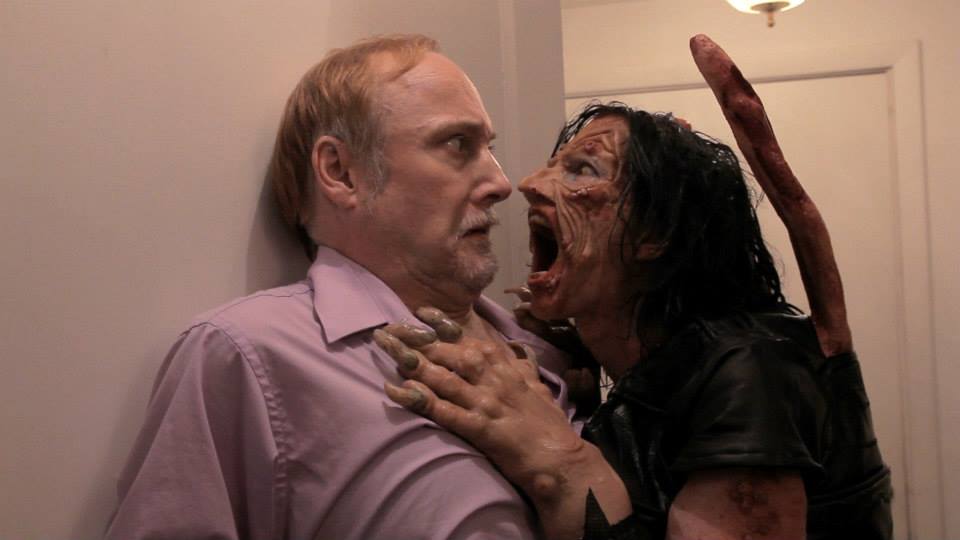
When I read Paul’s screenplay for KILLER RACK, I knew I had to direct it. I also knew that Michael had co-created his character and was part of the package, and I doubted he was physically able to handle a large part again. After his first day of shooting I was convinced he would have to be replaced: he was so weak that he had a hard time projecting his voice. I told Paul my fears. I told Michael my fears. And Michael not only stepped up his game, but gave his best, downright brilliant, performance as Detective Bartles, opposite Alex as Detective James. The film screened at many film festivals and received glowing reviews, and Bartles and James became fan favorites. It was extremely gratifying for Michael, and he, Alex and Paul discussed doing a spinoff, but it never happened; life got in the way for everyone.
Michael was a fan of my novel Johnny Gruesome, but I didn’t have a part for him in the film version we did a few years ago. John convinced me to include him in some way, so I gave him a cameo as a funeral director. That was John being a true friend when I was focused on the project. When it came time to shoot WIDOW’S POINT, one sequence called for four guys to play poker in our haunted lighthouse in 1933. It was a chance to put John, Paul, Michael and Bill Brown together one more time. I don’t know anything about poker, so we all got together and rehearsed a scene I hadn’t even written, which was a lot of fun. The final sequence is pretty short, but an extended version will appear as an extra on the DVD. During editing I realized that Michael had given the most natural performance I’d ever seen from him; he even got to laugh (appropriately enough, at John’s character). The film will be released in September, and it’s hard to believe that was the last time I will ever direct Michael.
Michael was part of my film family, but he was part of the larger Buffalo film community as well, and the theatre community: he appeared in so many shorts and features that his IMDB page isn’t even close to comprehensive, and he was a “go to guy” for many local directors. People attending Buffalo Dreams were used to seeing him on screen throughout the festival, not just shooting photos of filmmakers at our banner. Almost every time I worked for Chris Ray, Michael was on board as an extra. The last time I saw him in person was in December, on the set of the action film ASSAULT ON VA-33. It was a cold shoot, and I saw him having trouble getting onto the floor where he spent most of his screen time, and then standing, and did my best to look after him. As always, he was happy just to be a part of something. Anytime I had to track down one of his fellow extras, I knew to ask him first.
Here is the fifth thing you need to know about Michael: he had a lot of friends, probably more than he realized, but he was a lonely man. He lived in Lewiston, a little too removed from the different circles he belonged to, and anytime he was not involved in a project it depressed him. He would post that he was not getting any roles, but in fact he worked on more projects than anyone. It is unfortunate that most of the outpouring of love for him came when he was on his deathbed, something we all need to consider, especially now, during this pandemic.
I regret that I couldn’t visit Michael at the hospital this all important last time because of Covid-19 concerns, and that I didn’t get through to his room via phone when he was still able to speak, but I’m glad I finally did get through at the end and told him how much he meant to me. I do most of my socializing on set and at the festival, and that’s how I spent most of my time with him – long, intense days – but I will remember him attending my daughter’s birthday parties, which often turned into raucous affairs after all of the “normal” people left. He was a better friend to me than I was to him, but I’m glad our films feature some of his best work.
I took it for granted that Michael would always be around, because he always was around, putting himself out there. Googling his name, I was surprised to find an excerpt from my novel The Frenzy Wolves – I had named a character after him and completely forgot doing so. I suspect many of us will look for ways to assign him posthumous cameos from now on. I looked at our personal FB messages before writing this. Michael dreamed of making a giallo film – an Italian style murder thriller – and in his last message to me said he wanted me to write it even though he could not pay me at the time because he was looking for work. I explained that my family was in the middle of a health crisis (which was only just beginning, unfortunately) and had to turn him down.
In March, Michael was admitted to Niagara Falls Memorial Hospital to have a kidney blockage removed. Complications kept him there for three months until he died. Things will honestly not be the same without Buffalo’s Donald Pleasance. I miss him already.
“Though I’ve belted you and flayed you,
By the livin’ Gawd that made you,
You’re a better man than I am, Gunga Din!”
(June 25th, 2019) The film “Aging Out” is a dramatic comedy, rooted in the love of a found family. The movie touches on some of the harsh realities of the adoption system. “Aging Out” displays diversity, togetherness, courage and sacrifice that family makes to stay together.
The movie, written and directed by filmmaker Greg Robbins, will begin principal photography in Buffalo, NY August 4, 2020. It will be the first film production to take place in Western New York in the slow return from COVID-19.
“Aging Out” already has a signed distribution deal with Bridgestone Multimedia Group. The film will feature local actors and will be worked on by local crew members, a 100% Western New York production. In light of COVID-19, intense planning is in process for the production of the film. There will be someone on set designated to controlling the spread of germs and to enforce safe practices amongst the cast and crew. Special attention is being paid to all news related to COVID-19 and adjustments will continue to be made as new information is released to ensure the safety of all cast, crew, and our community.
For more information on “Aging Out”, follow the movie’s Instagram, Twitter, and Facebook
pages @AgingOut_Movie
Two ordinary guys embark on an extraordinary adventure and risk everything for a stranger in need. “Cold Brook” marks the directorial and screenwriting debut of actor and Cheektowaga native William Fichtner. He also stars in this feature alongside “Sons of Anarchy” star Kim Coates and “Oz” star Harold Perrineau.
After a successful festival and theatrical run “Cold Brook” is airing now on “Showtime” and Video on Demand.
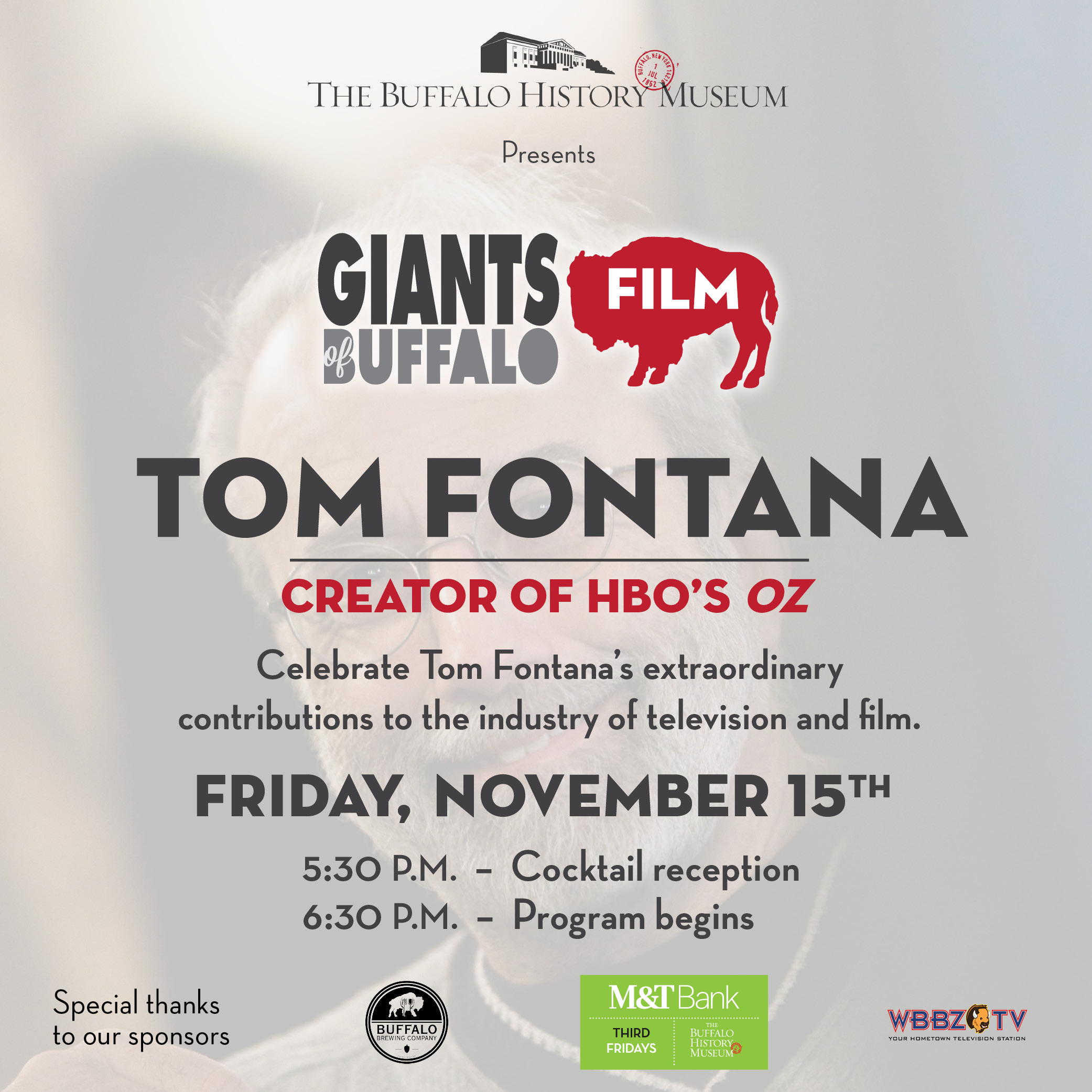
Buffalo, N.Y. (November 5, 2019) – The Buffalo History Museum continues its tradition of Giants of Buffalo, a series of programs dedicated to individuals who have made extraordinary contributions in their life’s vocation, with “Giants of Buffalo Film: Tom Fontana.”
Tom Fontana is a Buffalo-born writer and producer, who, among many other accomplishments, is known for the creation of HBO’s “Oz” and NBC’s “Homicide: Life on the Street”. He has written articles for The New York Times, TV Guide, and Esquire, produced numerous plays from theatres in New York City to San Francisco, and has taught at universities and colleges, including the State University College at Buffalo, his alma mater, from which he received the Distinguished Alumni Award and an Honorary Doctorate of Letters.
The program will engage the audience in an informal talk-show format about Fontana’s personal stories as experienced by career choices, industry practices of the day, impact on our region, and inevitable changes. The program will be moderated by Steve Cichon, author of a number of books on Buffalo’s history, writer of BN Chronicles, historian, and local radio and TV personality.
Event Details:
Time: 5:30 p.m. Cocktail Reception | 6:30 p.m. Program Begins
Date: Friday, November 15, 2019
Place: The Buffalo History Museum, One Museum Court, Buffalo NY
Admission: Members $10; General Admission $25; Patron $50
Tickets: Online; by phone at (716) 873-9644 ext. 309; or in person with Guest Services
For more information, call 716-873-9644 or visit us online at www.buffalohistory.org. Program is generously sponsored by M&T Bank and the M&T Third Fridays series, Buffalo Brewing Company, and WBBZ TV.
About The Buffalo History Museum The Buffalo History Museum has been Western New York’s premier historical organization since 1862. We are the keepers of the authentic stories that make our community unique. Our collections, exhibits, and programs tell the stories of the people, events, and movements that demonstrate Western New York’s essential place in shaping American history.
The Buffalo History Museum is a private not-for-profit organization tax exempt under Sec. 501(c)(3) of the Internal Revenue Code. We receive operating support from the County of Erie, the City of Buffalo, New York State Council on the Arts with the support of Governor Andrew M. Cuomo and the New York State Legislature, and from donors, members, and friends. The Buffalo History Museum is accredited by the American Alliance of Museums.
WKBW radio’s “War of the Worlds”, the most famous radio broadcast in Buffalo history, will be celebrated with the screening of the documentary film “WKBW Radio’s War of the Worlds, The Legacy Continues” tonight, October 30th at the historic Aurora Theatre at 7 PM.
The documentary screening will be followed by a live Q & A featuring WBEN personality and Hall of Fame broadcasters Sandy Beach and Pat Feldballe and documentary producer Bob Koshinski. Beach, Feldballe and Koshinski will be available for interviews at 6:30 PM in the lobby of the Aurora Theatre on Main Street in East Aurora.
The documentary features interviews with the late Jeff Kaye, Irv Weinstein, Jim Fagan and other members of the original cast of KB radio’s War of the Worlds. Also, in the film are iconic radio legends Sandy Beach, Dan Neaverth, Dan Kriegler, John Zach, Pat Feldballe, Jim Pastrick, Tom Atkins and John Hager. Film and television actor William Fichtner and television and film producer Nick Bakay, who both grew up in Buffalo, share their memories of the Buffalo Halloween broadcast along with Buffalo Broadcasters Chairmen Emeritus Dave Gillen, Entercom Operations Manager Tim Wenger, 97 Rock Promotions Director Dave Jickster and famous Blasdell restaurateur Dennis DiPaolo.
WKBW Radio’s War of the Worlds, The Legacy Continues is sponsored by the Buffalo/Niagara Film Office and the Niagara Falls Culinary Institute.






 Event Details: